

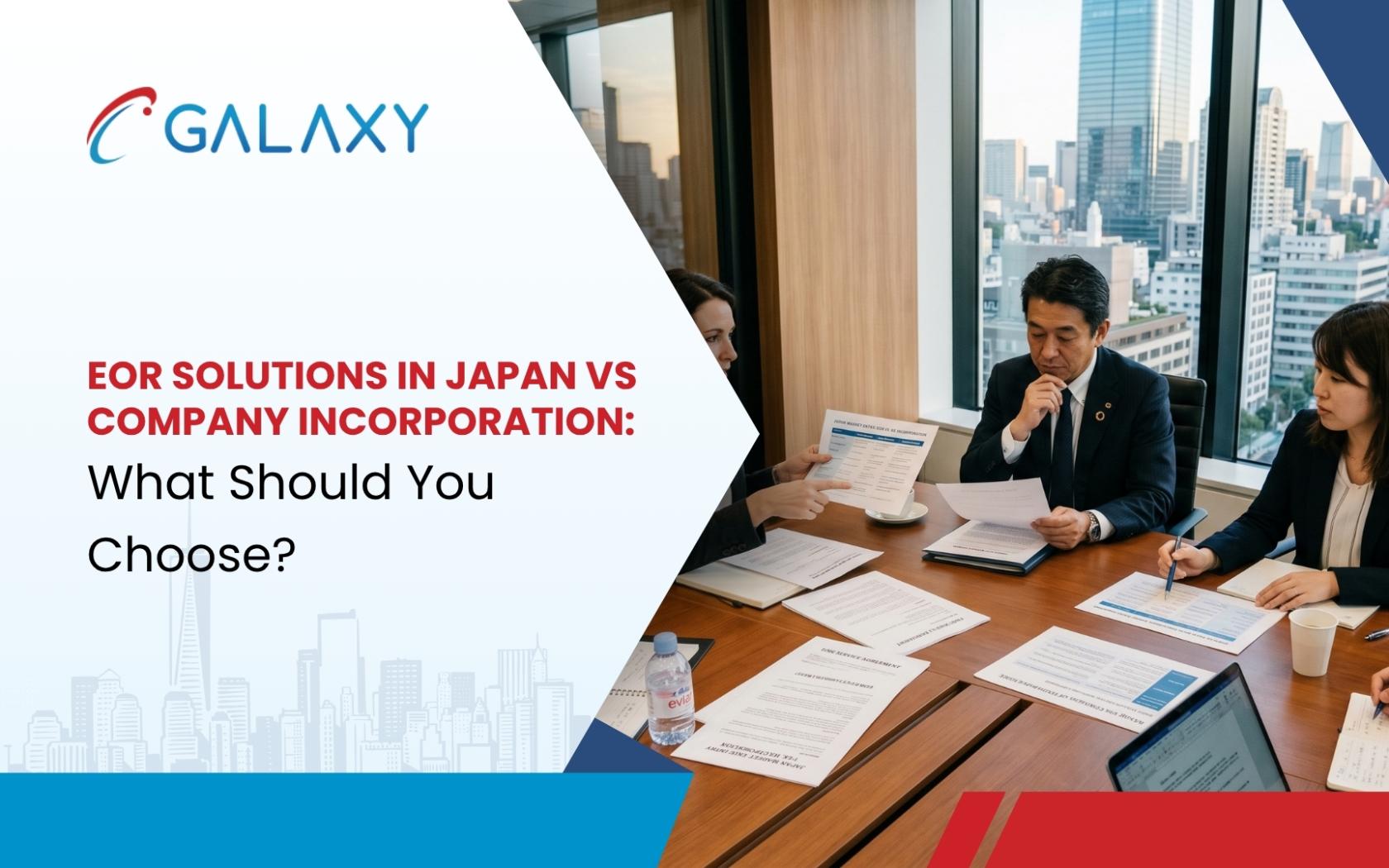
Japan is one of the most rewarding markets in Asia, and also, one of the most unforgiving if you do not follow the right practices. Before committing to full incorporation, most global businesses should seriously consider EOR solutions in Japan as a faster, lower-risk entry route. This post lays out exactly when each option makes sense.
Most companies that expand into Japan start by assuming incorporation is the end goal. But there's a difference between Japan being your long-term strategic market and Japan being somewhere you're trying to hire two engineers right now.
That distinction (between ambition and immediate need) is where the incorporation-versus-EOR decision actually lives. If you get it wrong, you're either locked into an expensive legal structure before you've proven market fit or you're paying employees in Japan without a compliant local entity and hoping nobody notices.
Here's what you need to know before you decide.
EOR solutions in Japan refer to Employer of Record services where a third-party provider legally employs workers on your behalf under their own registered Japanese entity. The EOR handles all payroll, tax, social insurance, and labor law compliance. You direct the work, they handle the legal and administrative employment obligations.
This model is used by global companies that want to hire in Japan without setting up a local entity. Mostly, by companies that want to test the market before committing to incorporation. For more on how EOR fits into a wider Asia-Pacific hiring strategy, theGalaxy APAC guide on managing global teamsIs worth reading alongside this post.
Most serious market entries use a KK. Most people who underestimate Japan's setup complexity chose a GK.
To better understand, read How to Set up a Company in Japan: A Complete Guide for Foreign Businesses.
Speed is the obvious advantage. WithEmployer of record in Japan, You can have a compliant employee hired and on payroll within days. There's no entity setup, no bank account, no notary visits.
That matters for specific situations:
Japanese labor law is strict and employer obligations are specific. An EOR absorbs those obligations entirely. The most common mistake companies make in Japan is incorporating too early. The second most common is waiting too long to transition away from EOR once the business is established.
There's a point where EOR starts to cost more than it saves.
Japanese companies and government bodies take local legal entities seriously. If you want to win meaningful enterprise contracts, bid on government procurement, or build long-term credibility with Japanese partners, a registered entity isn't optional. Japan is a trust-based market, and operating purely through an EOR arrangement can limit how seriously local stakeholders take you.
The signals that incorporation has become the right move:
Is it legal to use an EOR in Japan without a local entity?
Yes. EOR is a fully legal and widely used employment model in Japan. The EOR provider holds a registered Japanese entity and employs your workers under that entity. You direct the work; they manage the legal employment relationship.
What are the main costs of incorporating in Japan vs. using an EOR?
Incorporation costs include government registration fees (from ¥150,000 for a KK), notary fees, professional service fees, bank account setup, and ongoing accounting and compliance costs. EOR charges a per-employee monthly fee, typically a percentage of salary or a fixed management fee. There is no entity setup costs. For small teams, EOR is almost always cheaper in the first two years.
Also read:Guide to setting up a company in Japan
Can an EOR handle Japanese payroll and social insurance properly?
Yes. A qualified EOR provider manages employer registration with Japan's social insurance system, including shakai hoken, kosei nenkin, and koyo hoken, as well as withholding tax obligations. This is what distinguishes a genuine EOR from a simple payroll processor.
Does using an EOR limit how we can operate in Japan?
For most hiring and employment purposes, no. The limitation is commercial: you can't sign Japanese client contracts as a local legal entity, bid on certain government contracts, or hold a Business Manager Visa through an EOR arrangement. If those things matter to your Japan operations, incorporation becomes necessary.
When should we transition from EOR to a local entity in Japan?
The clearest trigger is sustained headcount growth past 10 employees, combined with commercial activity that requires a local entity. Example, client contracts, regulatory approvals, or long-term lease agreements. Most companies find the transition makes economic sense somewhere between 12 and 24 months after initial market entry.
EOR and incorporation are not competing strategies. They're sequential ones. Most companies that incorporate in Japan successfully spent 12-24 months with an EOR first.
If Japan is a strategic long-term market and you're ready to commit the capital, the time, and the internal resources, then you should incorporate. Start the process now, because it takes longer than you think.
Start with EOR first if Japan is still a question mark, or if you need people on the ground within weeks rather than months.
Galaxy APAC provides EOR and payroll outsourcing services across Japan and the broader Asia-Pacific region, built for international businesses that want to hire compliantly without the overhead of premature entity setup.Explore how Galaxy APAC can support your Japan market entry.
External reference:JETRO's guide to establishing a business in JapanProvides the authoritative regulatory framework for foreign companies considering incorporation.

財華網所刊載內容之知識產權為財華網及相關權利人專屬所有或持有。未經許可,禁止進行轉載、摘編、複製及建立鏡像等任何使用。
如有意願轉載,請發郵件至 content@finet.com.hk,獲得書面確認及授權後,方可轉載。

Galaxy APAC(主要營運實體為 Galaxy Payroll Group Limited,納斯達克代碼:GLXG)旗下擁有多間負責不同地區業務的營運子公司。 www.galaxyapac.com 根據其公開披露資料,主要的子公司名稱如下:Galaxy Payroll Services Limited (Galaxy Payroll (HK)):位於香港,是集團的主要營運實體,
 或
或 按钮分享
按钮分享